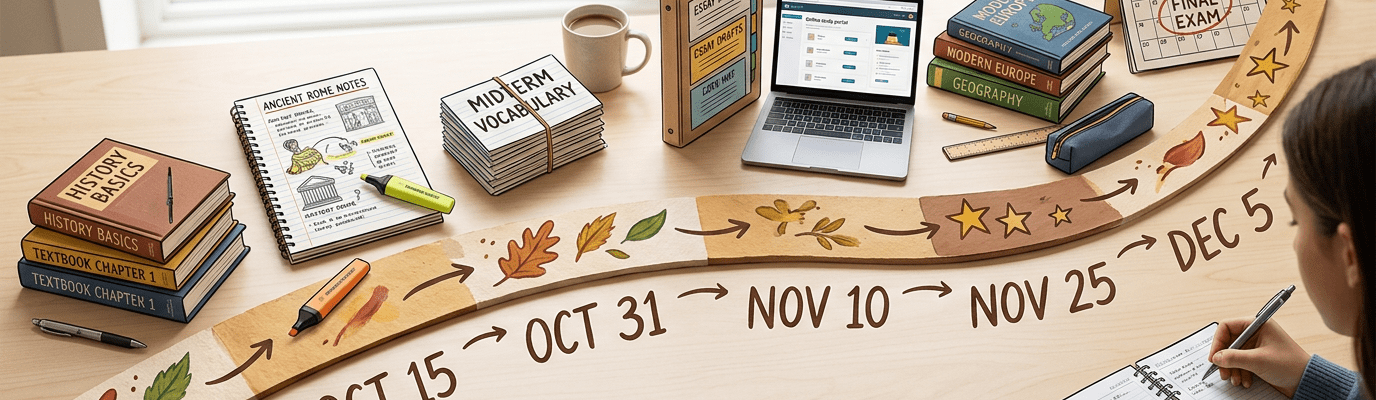
Why does cramming fail while spacing works? Spaced repetition learning leverages the spacing effect to strengthen synaptic connections through retrieval practice—forcing your brain to reconstruct memories rather than passively review them. This learning science approach explains how deliberate gaps between study sessions accelerate skill acquisition and cement neural pathways far more effectively than massed repetition.
⏱ CHAPTERS
0:00 Intro
1:20 Spaced Rehearsal for Better Memory Retention
2:25 Importance of Rest and Recovery in Learning
4:02 Example Study Schedule for Spanish History
5:42 Frequency Over Duration in Studying
9:37 Strategic Planning Based on Learning Phase
11:14 Deliberate Practice vs. Mere Practice
16:19 Slow Down to Learn Better
20:06 Interleaving as a Study Method
26:07 Benefits of Spaced Repetition in Memory Formation
In each video, Peter Hollins delves into the fascinating world of neuroscience to uncover secrets that can boost your memory retention and overall learning efficiency. From exploring the science behind repetition learning and spaced repetition to mastering study techniques like active recall and interleaved practice, you’ll gain insights on how to optimize brain pathways for better mental performance and self-discipline.
You’ve probably done this.
You practice something for hours, feels productive.
A week later, you write back where you started.
Or you cram before a test and you may ace it, and then you forget everything by the weekend.
It’s not a discipline problem.
It’s not even a talent problem.
It’s that most of us were never taught how repetition actually works, and the version we default to is almost the exact opposite of the version that works.
Today, we’re looking at what the science actually says about repetition, why how you repeat something matters more than how much, and what’s physically happening in your brain when it finally does stick.
The first two pieces in this episode come from Peter Hollins’ book, The Science of Rapid Skill Acquisition, his book on how to actually get good at something fast instead of just putting in the hours.
Then we’ll bring in another book of his, Build a Better Brain, to look at the neuroscience underneath it, why this method works at the level of your actual brain tissue, not just to study, say.
Spaced repetition, otherwise known as distributed practice, is just what it sounds like.
In order to commit more to memory and retain information better, you space out your rehearsal and exposure to it over as long a period as possible.
In other words, you can learn information and skills far better if you study it for one hour each day versus 20 hours in one weekend.
Similarly, research has shown that seeing something 20 times in one day is far less effective than seeing something 10 times over the course of 7 days.
So much for cramming.
What does this say about how to practice?
Spaced repetition is the concept that 5 minutes a day is far superior to learning and memory than an hour a week.
When you focus on frequency of learning versus duration or even intensity, you will learn better.
Focusing on duration usually becomes motion for motion’s sake and can oftentimes become detrimental overall to your goals.
It makes more sense if you imagine your brain as a muscle.
Muscles can’t be exercised all the time and then put back to work with little to no recovery.
Your brain needs time to make connections between concepts, create muscle memory, and generally become familiar with something.
Sleep has been shown to be where neural connections are made, and it’s not just mental.
Synaptic connections are made in your brain and dendrites are stimulated.
If an athlete works out too hard in one session, like you might be tempted to in studying, one of two things will happen.
The athlete will either be too exhausted and the latter half of the workout will still have been useless, or the athlete will become injured.
Rest and recovery are necessary to the task of learning, and sometimes effort isn’t what’s required.
So when you focus on frequency, suddenly you have a clear structure to organize your practice with.
Without a plan in place, most people will just study and practice until their eyes or fingers bleed and they collapse from exhaustion.
But that’s not working smart, just hard.
If you follow what spaced repetition prescribes, you’ll have your schedule for optimal learning set up for you.
Let’s take studying for a topic you have trouble with, Spanish history.
If you have trouble with this topic, that just means even more frequency should be devoted to it.
A study or practice schedule focused solely on duration would be relentless from Monday to Sunday.
Here’s a look at what an optimized schedule focused on frequency might look like.
Monday at 10 am, learn initial facts about Spanish history.
You accumulate five pages of notes.
Monday at 8 p.m. Review notes about Spanish history, but don’t just review passively.
Make sure to try to recall the information from your own memory.
Recalling is a much better way to process information than simply re-reading and reviewing.
This might only take 20 minutes.
Tuesday at 10 am.
Try to recall the information without looking at your notes much.
After you first try to actively recall as much as possible, go back through your notes to see what you missed and make note of what you need to pay closer attention to.
This will probably take only 15 minutes.
Tuesday at 8 pm.
Review notes.
This will take 10 minutes.
Wednesday at 4 p.m.
Try to independently recall the information again and only look at your notes once you’re done to see what else you’ve missed.
This will only take 10 minutes.
Make sure not to skip any steps.
Thursday at 6 p.m. Review notes.
This will take 10 minutes.
Friday at 10 a.m.
Active recall session.
This will take 10 minutes.
Looking at this schedule, note that you’re only studying an additional 75 minutes throughout the week, but that you’ve managed to go through the entire lesson of whopping six additional times.
Not only that, you’ve likely committed most of it to memory because you’re using active recall instead of passively reviewing your notes.
Even if you take your time to be thorough and double the overall time to 150 minutes, it’s still a fraction of what you would have previously spent to do far less.
It’s astonishing what you can accomplish in short periods of time if you focus on frequency and you don’t allow yourself to drift.
Scheduling relatively shorter time periods for material keeps you on your toes and not slipping into laziness if you were to schedule huge blocks of time for one task.
You’re ready for a test the next Monday.
Actually, you’re ready for a test by Friday afternoon.
Spaced repetition gives your brain time to process concepts and make its own connections and leaps because of the repetition.
Think about what happens when you’ve repeated exposure to a concept or skill.
For the first couple of exposures, you may not see anything new.
As you get more familiar with it and stop going through the motions, you begin to examine it on a deeper level and think about the context surrounding it.
You begin to relate it to other concepts or information, and you generally make sense of it below surface level.
There is no mindless motion.
It must be active and engaged, which you can only do in short spurts.
Flashcards are particularly useful for this, especially if you keep shuffling them and putting them into different orders.
It also helps to pick out a different starting spot in the material for each session, so you’re mixing up the order and aren’t just going over the same spots each time.
The idea is to keep injecting freshness and different perspectives on the same material that you’re seeing multiple times a day.
All of this is designed to push information from your short-term memory into your long-term memory.
That’s why cramming or studying at the last minute isn’t an effective means of learning.
Very little tends to make it into long-term memory because of the lack of repetition and deeper analysis.
At that point, it becomes rote memorization instead of the concept learning we discussed earlier, which is destined to fade far more quickly.
Hopefully, from this point on, instead of measuring the number of hours you spend on something, try instead to measure the number of times you can revisit it.
Make it your goal to increase the frequency of reviewing, not necessarily the duration.
Ideally, you have both, but the literature on spaced repetition makes clear that breathing room is more important.
Spaced repetition generally has two different uses.
You can use it for initial learning, but you can also use it to prevent forgetting and to ensure things stick in your brain.
The above example was focused on the initial learning phase, but a sample schedule to prevent forgetting and simply keep things in mind will look a bit lighter.
It will strategically touch upon information just enough to keep it in your mind, but not too much as to waste time or hit the point of diminishing returns, which is when you’ve already memorized it.
For example, Monday, 12pm, Wednesday, 12pm, Saturday, 12pm.
Our brains don’t necessarily want to remember more than is necessary and will dump information at the first opportunity, so spaced refreshing is far superior than one large block of time on one day.
Imagine a path in a garden that gets warned with time.
The path is a memory in your brain, and it takes a certain amount of repetitions to become deep enough to stand on its own.
Even a few repetitions can make a huge difference as to how clear the path becomes and how long the path will last.
If you’re really pressed for time, just know that studying something twice is better than once, almost always.
If you want to improve your memory and skill instantly, review something for 15 minutes before you sleep at the end of your day.
That’s all it takes to get a head start on others and learn better.
Just in case you’re looking for a more step-by-step guideline on using spaced repetition and optimizing for frequency, here are four points.
1.
Copy my study plan regarding Spanish history.
Seven times a week sounds like a lot, but in reality it ends up only being an extra one to two hours.
This helps you keep focus and capitalizes on the way your brain prefers to absorb information.
Calibrate your plan to whether you’re in the initial learning phase or the don’t forget phase.
2.
Prioritize frequency.
at least once a day, but ideally twice a day over the course of a week.
Measure in terms of how many times you can get through the material, repetitions, and not how long you spend on it.
Again, calibrate this to whether you are in the learning phase or the don’t forget phase.
3.
Engage with the material each time, and don’t just go through the motions.
This might require you to create different and creative ways to look at the same thing over and over.
As mentioned, you can use different starting points, different flashcards, and overall different ways of reading the same material over and over.
Vary the input method here.
4.
Test yourself.
Don’t skip over things and don’t just review, read or recognize.
If it feels too easy, you aren’t learning optimally.
The first three sections of this chapter likely present the idea of mere practice in a far different light than you’re used to.
But hopefully, instead of creating the feeling of dread, it creates the feeling of unleashed potential as you realize what you haven’t been taking advantage of.
Once again, that’s from the Science of Rapid Skill Acquisition.
The links are in the description if you want to take a look at the full method.
So we’ve seen that spacing things out solves when you practice, but there’s a second variable that matters just as much.
How you practice within each session.
That’s where deliberate practice comes in.
Deliberate practice is purposeful and systematic.
Regular practice or rehearsal might entail review, repetition and rote motions, but deliberate practice requires focused attention with the specific goal of improving performance as a whole.
This is because the natural tendency of the human brain is to transform repeated behaviors into unconscious habits, and thus, we cannot ensure that each of our behaviors is exactly what we want.
For example, when you first learned to tie your shoes, you had to think very carefully about each step of the process.
If you learned it incorrectly at first, it was probably difficult to change to a more correct method.
Then, over time, you didn’t even have to think about it.
As it becomes more natural, we can process the sequence of operations automatically.
But you had to correct that error, otherwise the knot would never stay tied.
To use deliberate practice, you first break your skill down into smaller components.
This is something we’re already familiar with from the previous chapter on deconstructing.
The next part is different from any other practice you’ve ever conducted.
You go through the motions a few times to see where you keep faltering.
Those parts, whether a phase of a skill or a topic you keep forgetting, are what you should focus on and drill repeatedly.
Putting deliberate practice to work in learning is not hard, just tedious and detail-oriented.
Computer science professor Cal Newport described how he mastered discrete mathematics.
This branch of math study, very briefly stated, involves finding proofs for theories.
Newport explained how he bought reams of white paper and then copied each proposition the professor would present at the top of each class session.
On his own, away from the classroom, Newport worked on the proofs.
When he came to a concept he didn’t understand, he consulted textbooks and online sources, in his own words, to see if I could make sense of what I was writing down.
Usually, the process secured Newport’s understanding of the problem.
If it didn’t, Newport consulted with his professor for feedback.
Near the end of the course, Newport had accumulated a massive stack of handwritten proofs.
He aggressively reviewed them.
He classified his proofs into ones that he could recall with little effort and those he needed to drill down.
He continued to study the problematic ones, repetitively, exhaustively, until he finally extracted the last bit of understanding from them.
After his final exam, Newport was told he’d achieved the highest grade in the entire class, not just on the final, but in the whole course.
This is deliberate practice in action.
Surveying the landscape, identifying the promomarias, repetitively and aggressively examining it, and continued tests of your competency or understanding.
Newport found what he was lacking, drilled without mercy, and then made sure his understanding was complete.
When you identify your overall goal as improved performance, it becomes clear on how to practice to build expertise.
You’re only as strong as your weakest links, so you must first address them.
Let’s take the familiar example of playing a new piano piece.
There are a few sections in the middle where your hands don’t seem to be working in sync.
Normal practice might dictate that you keep zipping through the entire song, despite the fact that you have some trouble spots in the middle and everything else is already proficient.
That’s what most of us will do.
But this is not the best use of your time.
Deliberate practice demands that you drop everything else and drill the weakness in the middle until it reaches a certain level.
It takes a skill component by component and ensures that each phrase is up to par.
Only then will overall performance be adequate.
Most any skill can be mastered using this intensive technique.
There’s really no prohibition on what you can learn through deliberate practice.
The enemy of deliberate practice is mindless activity and motion for motion’s sake.
And the danger of practicing the same thing over and over is that we’ll assume we’re making progress merely because we’re gaining experience and additional exposure.
But in truth, all we’re doing is reinforcing our current bad habits.
We’re not improving or changing them.
Don’t confuse improvement with repetition because they are far from being the same.
Improvement comes with repetition, but repetition by itself is worthless in your pursuit of rapid skill acquisition.
Additional points in effective practice include the following.
Practice Sessions There is an optimal amount of time you should practice, believe it or not.
Many studies say that our energy levels correspond to daily cycles, and they mirror the 90-minute duration of REM sleep cycles.
But the truth is, the perfect length of a practice or study session will differ for everyone.
Make sure you aren’t practicing so long that you’re burning out, but you’re practicing long enough that you aren’t bored or disengaged and don’t allow yourself to get into the zone.
Anything else just becomes repetition.
In fact, you should ensure that you stop before your practice begins to get sloppy because of the next point.
Muscle memory sees what it sees.
In other words, it doesn’t discriminate between what is good practice and what is bad practice.
Consequently, it doesn’t discriminate between good and bad habits.
They just remember what they’re exposed to.
This is why mistakes can be so difficult to crack.
They’re as much a part of your memory as the good parts.
Perfect practice makes perfect skills, so this compounds on each of the earlier points on learning slowly, practicing well, and stopping before you get sloppy.
On the same note, slow down your learning.
Start slow, learn slow, and don’t let your impatience get the best of you.
When you learn slow, you put yourself in the best position for success because everything is done correctly and accurately.
If you don’t learn slow, you’ll find that you often can’t slow down later because you’ve not adequately learned the intermediate steps involved.
Increase your tempo later.
What’s the rush?
Patience.
As if you needed to be reminded of patience again.
but acquiring a skill is more than simply swinging a racket or understanding why your fingers should move in a certain way.
It is the process of building muscle memory and research has indicated that it can take up to 1,000 repetitions on the lower end for simpler skills and 30,000 repetitions on the higher end for more complex skills to be cemented and become second nature.
Let’s suppose you play a difficult piano piece for an hour a day.
You can get through the piece 20 times in that hour.
Even if you shoot for a thousand repetitions, that’s not going to be a short amount of time any way you slice it.
So be as patient as possible and manage your expectations.
Interleaved Practice
This method of practice is much different from what you might have previously considered gospel.
Devoting time to learning one subject in uninterrupted blocks, like eating all your vegetables first before eating your dessert.
It turns out this isn’t the optimum way for the brain or muscles to absorb information.
Using uninterrupted blocks involves learning or practicing one skill at a time before progressing to another one.
You don’t move on from working on one skill until you’ve completed the routine.
You finish skill A before skill B, and finish skill B before moving on to skill C. Representing study time units as one letter, this practice would establish a pattern that looks like AAABBCC.
Interleaving disrupts that sequence.
It mixes the practice of several related skills throughout a single study session.
where a typical study session might look like AAA, an interleaved study session would look more like ABC.
For example, a beginning algebra student may be tasked with comprehending exponents, graphing, and radicals.
Instead of taking each subject one at a time, they should start with exponents, break off and practice graphing, then work on the radicals of square roots, and then go back to studying exponents.
When studying Shakespeare, one could divide portions of a study session by switching between the playwright’s comedies, tragedies, and historical plays.
Taking it to another level, you could simply study Shakespeare, then mathematics, and then African history, all in the same study block.
Interleaved practice at first might seem a haphazard, somewhat randomized way of learning in comparison.
It might also seem that you just can’t synthesize information when you interrupt its percolating in your brain so frequently.
But which method actually works best?
Research indicates that interleaving is actually much more effective for motor learning and cognitive tasks.
Its advantage over block learning is surprising.
Interleaving produces a 43% increase in learning and retention over block learning.
There are a few reasons for this.
First, interleaving pushes a student out of their comfort zone.
Remember that the harder the practice, the more effective the learning generally is.
Second, interleaving breaks any patterns and familiarity you have with a certain topic in isolation.
This disruption forces you to practice active recall more and leaves you unable to passively review information.
Third, and perhaps most importantly, the blending of concepts or problems builds and reinforces stronger connections between them.
Students generally perceive concepts and skills as freestanding, self-contained bits of information with no apparent or obvious connections to other bits.
But the more often we can connect information or skills with other things we already know, the more likely we are to understand and remember the information.
Blazeman 2017
Regularly interleaving material and skills facilitates discovery of these connections and encourages us to find unexpected bridges for ultimately better retention between different skills and ideas.
The benefits of interleaved practice are twofold.
First, it improves the brain’s ability to discriminate between concepts.
In blocking, once you know what the solution is, the hard part’s over.
With interleaving, each practice varies from the last, so rote or automated responses don’t work.
Instead, your brain has to continually focus on finding different solutions.
This process sharpens your ability to learn critical features of skills and concepts, which therefore helps you select the correct response and execute it.
Interleaving also strengthens memory associations.
In blocking, you only need to hold one strategy in your short-term memory at a time.
In interleaving, the strategy will always be different because the solution changes from one attempt to the next.
Your brain is relentlessly engaged and calling forth different responses and bringing them into your short-term memory.
Again, it’s an active and more challenging approach, but it reinforces your neural connections among different tasks and responses which enhances and improves learning.
The most important tip to remember is that interleaving isn’t the same as multitasking, which you should avoid.
Don’t play too loosely with the disciplines you’re learning.
Interleaving between chemistry, English literature, and ceramics is probably more trouble than it’s worth, not to mention messy.
Rather, within a single study session, move between multiple topics.
Try to set a limit on how many different angles or subjects you’ll handle in a given study block.
Three is enough, and four might be good for intense sessions.
But once you’re in, feel free to let your instincts guide you from topic to topic.
Setting a timer for each topic is fine, but for some, the enforcement of an artificial limit might not be ideal for comprehension purposes.
Even if the subjects you interleaf don’t vary too wildly, you still have some wiggle room.
For example, you can juggle readings in English literature, European architecture, and Greek philosophy without too much shock to the system.
subjects that spur the finding of connections are especially helpful.
Blending studies in art theory, art technique, and the history of pop cultural art of the 60s could very well produce meaning that can easily be shared across all three concepts.
Similarly, working on a set of scales on your guitar, then chord progressions, then picking exercises all fall under the same umbrella and can create a sort of synergy.
As with everything we’ve discussed thus far, the truly most important factor in learning is how much attention you can pay and how well you can focus.
Interleaving might help keep things fresh for you, or it might prove too spastic and unable to allow you to focus in shorter periods of time.
Used with caution, it doesn’t necessarily matter what is scientifically proven sometimes.
So that’s the how.
Space it out, and within each session, drill your actual weak points instead of repeating what you’re already good at.
Here’s the question that’s easy to skip past.
Why does this work?
Why does the brain respond to spaced, targeted repetition specifically instead of just rewarding raw hours?
Well, now it’s not really a learning question anymore.
It’s a neuroscience question.
So let’s switch books for a minute, because Holland’s actually answers this directly in build a better brain.
Like any meaningful change, brain plasticity requires time, patience, and practice.
It’s not something that can be rushed through, and there is no quick and easy fix.
A systematic and consistent approach is the best one to take when working on sharpening your brain.
Even though we’ve used the Zen Garden example frequently, for this principle, it’s more illustrative to think about how the Grand Canyon was formed.
At the bottom lies a small river, and through millions of years, this river slowly carved a chasm in the earth that is one of the biggest of its kind.
That’s an oversimplification of geography, but the idea that neuroplasticity is a long process should be clear.
Researchers Jeffrey Klein and Teresa Jones came up with some guidelines for being methodical and persistent in neuroplasticity.
They developed these guidelines in the context of helping victims of strokes and brain injury recover, but they can be appropriated for anyone trying to improve and strengthen their neural pathways.
They generally found that the number one indicator of recovery was, you guessed it, consistency over time.
Habits aren’t formed in a day.
In fact, studies have shown it takes at least two months to form a habit, and it’s near impossible to memorize all 50 states of the United States in one sitting.
Your hair only grows millimeters a week, and your neurons don’t forge connections instantaneously.
Things take time.
Use it or lose it.
As we’ve mentioned before in this book, neural pathways that are not being actively used instead get pruned.
This is mainly a directive for you to keep at whatever efforts you’re making and to engage as fully as you can to keep those pathways active.
Pruning will inevitably happen, so it’s important to focus on the functions and knowledge you want to develop to keep their respective pathways in the brain intact.
repetition matters.
Practice will pay off.
When you find a course of action you want to focus on, be prepared to repeat it.
Neural pathways respond to repeated practice by becoming more ingrained and it gets easier as you go along.
Just like reps in the gym do with our physical abilities, repeated exercises in building neural pathways will make your brain functions more automatic in time.
Intensity matters.
Climb in Jones also discovered that neural pathways respond more strongly to intense retraining.
Although you may feel initially resistant to tasks that might seem a little too difficult or hard to grasp, those are exactly the kinds of efforts that will have the most effect on your synaptic connection.
Sprinting is more beneficial than leisurely jogging.
Learning a complex foreign language is one of the best ways to raise your mental level of intensity.
If you’ve been intimidated by higher math studies like calculus, applied mathematics, or trigonometry, try teaching them to yourself from the ground up.
That goes for any subject that tends to scare off people, be it art appreciation, law, complex science, or classical music theory.
Salience Matters
why you’re embarking on efforts to improve neuroplasticity is just as important as how you go about them.
If you’re pursuing a line of activity that doesn’t have any relevance to you or your life, it’s not going to be as effective.
If you’re still deciding what to do, take some time to choose what kind of practice is going to mean the most to you.
If you’re in the middle of a course and discover it’s not that critical to your needs, you may want to rethink and refocus your energies into one that is.
transference and generalization matter.
Learning a new skill is especially successful when you can apply what you’re learning to multiple scenarios or functions.
Something that’s specific to only one or two subjects won’t have any relevance in a more generalized way, though they may be extremely helpful in narrower fields.
Try to employ at least a few adaptable areas of focus that will come in handy in multiple scenarios.
The act of thinking how you can apply it in different contexts will also help.
Learning a foreign language instills educational strategies that can help you with another language.
If you learn French, you might be more able to learn Spanish at some point.
So that’s the full picture.
Spaced repetition and deliberate practice aren’t just productivity hacks.
They’re the two conditions your brain actually needs to build new neural pathways.
Skip the spacing and you’re cramming.
It feels productive, but it doesn’t stick.
Skip the targeting, and you’re just repeating what’s already easy.
You need both, and now you know why.
If you want the full breakdown, both these books are linked in the description below, The Science of Rapid Skill Acquisition and Build a Better Brain, both from Peter Hollins.
If you want more on how the brain actually works day to day, that’s most of what I cover on the main channel linked below.
New episodes every week.
Subscribe if this was useful.

